Prologue
Hello, I'm just your typical twenty-something guy. I've always been interested in ancient mysteries and alternative archaeology. I'm not entirely sure what first piqued my curiosity on these subjects, but it's probably a combination of my personality and a television mini-series called Encounters with the Unexplained hosted by a fellow with a powerful and suggestive, almost hypnotic, voice by the name of Jerry Orbach. I watched this mini-series over 10 years ago, when I was in 6th grade, and its episodes, as the show's title would suggest, presented an event, monument, etc. from an alternative perspective, eschewing the mainstream or conventional view. Some of the topics featured in the episodes were the question of how and by whom the pyramids of Giza in Egypt were built, the Shroud of Turin's and its age, the Roswell Incident and speculations about a "cover-up," and so on.

I don't know if the show ever aired a complete episode on Atlantis, but as for myself, I never saw it if it did, though I do vaguely recall watching something about the Bermuda Triangle. But I remember telling my friends about what I had "learned" from the show, presenting as established fact what were wildly speculative hypotheses. It began with the notion that the Great Pyramid of Egypt was not built by what we know as the Dynastic Egyptians, but by an older civilization lost in the mists of time, and continued on to the fringe-of-the-fringe theories about ancient astronauts, putatively aliens, visiting humanity in prehistory. I first encountered this bold hypothesis in the context of the Pyramids of Giza, but was presented to it in full by bestselling author Erich von Daniken's Chariots of the Gods?. How I came to stumble upon this book was perhaps best described as 99% coincidence and 1% luck.
In my local library in Anaheim Hills, which is my hometown, there was a section just inside the entrance of the library reserved for books on sale for a nominal price, anywhere from a quarter to a dollar. Most of the books were old romance novels, and there was a smattering of books from bestselling authors such as Stephen King. One book that I happened to see one day here was Chariots of the Gods? I put a quarter or several into the coin drop box and purchased the book, not knowing that I had stumbled upon a book that had such a widespread currency.
Being an impressionable and eager twelve-year-old who had a lot of leisure time and as yet few responsibilities or schoolwork, I devoured my newfound book, believing most every word of it, or at least what I could wrap my head around. Regardless, I do not ever recall having been acquainted with the word Atlantis, let alone learning anything substantive about it at this stage of my life. In fact, my first introduction to the world of ancient mysteries and alternative archaeology proved to be a brief one, lasting only for the duration of sixth grade school year, too brief for the Atlantis meme to ever bubble up to my conscious awareness and attention. The questions that were raised by the television series Encounters with the Unexplained and the book Chariots of the Gods? were to be buried deep within the recesses of my subconscious mind, not to resurface for almost ten years.

In my third year of university, I decided to take an introduction to political theory course to fulfill my general education requirements. It was a course all political science majors had to take, and was the first course in the department listed in the catalog. For a lower division introductory course, it was very philosophical in nature and made scant mention of politics, echoing the words of Greek philosopher Plato, who famously renounced a life in politics for one of philosophy. It is through this course that I first became acquainted with Plato, and specifically through his most renowned work The Republic. I found The Republic to raise provocative questions in my mind, questions that I now believe, though I am not certain by precisely what steps, reawakened the long dormant intellectual side within me. The ideal city of Plato seemed to me all too real. I found myself being drawn into the dialogue and its interlocutions, unreservedly agreeing with some points made and vehemently opposing others. I found myself agreeing with Plato's pronouncements within the sphere of the psyche of the individual man, particularly in his defining a just soul as that one in which the elements of reason, passion, and appetite are placed in their proper hierarchical relations. Furthermore, I also agreed with his conception of a just society as one in which these same attributes of the soul are placed in the self-same relations as they are in the just soul; that is, which reason ruling over passion, and passion ruling over appetite. Where I found myself in disagreement with Plato was on a subtle point; I disagreed with the ordering of a man's soul constituting the basis for a just social order on account of my belief that an institutionalized social order based upon such a criterion, in subordinating the individual to the society in such a manner, is itself an act of injustice.

When did I first come across the two dialogues of Plato, the Critias and the Timaeus, that tell the story of Atlantis? I actually do not remember exactly; it was some time during the fall term of my senior year of college. But what I do remember is that the dialogue of Atlantis immediately took a hold upon my mind, even more so than the Republic. I began to read everything I could about Atlantis, starting by doing some Googling and reading the Wikipedia article on Atlantis, and soon found myself reading the classic bestseller Atlantis: The Antediluvian World written by Ignatius Loyola Donnelly and published in 1882. For a brief moment in my life, I was spirited away to the world of the 19th century, and I marveled at the spirit of that age and the boldness of the men and ideas thereof, which seemed like a veritable golden age of progress. I felt that the culture of scientific inquiry was actually more conservative now than it was then, to my surprise.
Why did I believe that I could find Atlantis when, evidently, all of the efforts to do so in the last two and a half thousand years had been for naught? Actually, I didn't really believe I could find Atlantis, and wasn't really even convinced of its existence, in spite of the voracious reading I had begun on the Atlantis legend. My years of uncritical acceptance of any new and edgy hypothesis had long since passed, and I had also managed to avoid the other extreme of dogmatic skepticism. It seemed obvious to me that the golden mean between these extremes was the epistemologically correct position, and what I surmised from my extensive reading of the Atlantis literature was that it was a fascinating story, and one worth dedicating more time to thinking about in my spare time. I approached the mystery of Atlantis with a matter-of-fact, "this is interesting," and noncommittal attitude.
The first thing I did after having perused the dialogues of Plato, the Critias and the Timaeus, and also Atlantis the Antediluvian World by Ignatius Donnelly, was to orient myself geographically. I tried to place myself in the mind and the worldview of the Mediterranean cultures, namely the Greek and the Egyptian, from whom the story of Atlantis could be traced. From my laptop in my dorm room, I downloaded Google Earth and started up the program. I centered my view over the Atlantic Ocean, high above the Earth that I could see the whole earth. As my eyes shifted to the right and hovered over the Mediterranean Sea, a seemingly unrelated fact came to mind, namely that this sea of such enormous size and historical significance, had at one time not existed. I recalled reading the abstracts of scientific papers that outlined the overwhelming evidence that the Mediterranean Basin had undergone at least one, and in all likelihood, multiple cycles of desiccation and reflooding, the last such cycle having occurred over 5 million years ago; in fact, for extensive periods of time, orders of magnitude greater in duration than the entire history of human civilization as know it, the Mediterranean Sea as it exists today was a dry basin of vast extent and depth, whose land would have been as far below the sea level as what is now seabed is today.
I wondered to myself whether such cycles of desiccation and flooding were unique to the Mediterranean Sea. Though I had no evidence to substantiate my belief, I thought that it was very much reasonable that other seas similar to the Mediterranean Sea, and located elsewhere on the globe, could have undergone such metamorphoses in the past. I thought that if it happened not only once but multiple times in the Mediterranean Sea, why couldn't it happen elsewhere? I was also aware of the fact that today, no such below sea level basins of such vast extent and depth as the dry Mediterranean Basin of the distant past exist. I wondered whether the nonexistence of basins of this type on our globe at the present day was, perhaps, an exceptional circumstance, so that for the greater portion of the earth's existence, there were at least one, and possibly multiple such basins of the Mediterranean type. And if the existence of such basins were indeed the rule rather than the exception, could it possibly have been that such a basin similar to the Mediterranean Basin existed contemporaneously with human civilization?
If the answer to this question were an affirmative, that is, such a dry basin similar to the Mediterranean Basin of over five million years ago existed in the geologically recent past, somewhere in the world, it would follow, from the fact of such a basin not existing anywhere in the world today, that it must have become refilled in like manner as was the Mediterranean Basin some five million years ago; that is, by a deluge in which the dry basin is engulfed by the waters of the ocean to which it is adjacent.
My eyes darted across the wide expanse of the Atlantic Ocean to the Caribbean Sea. And then it hit me. I hypothesized that the cycles of desiccation and reflooding undergone by the Mediterranean Sea millions of years ago had occurred much more recently with the Caribbean Sea so that prior to a certain time, a time within the memory of humanity, the Caribbean Sea had not yet formed, and that in that now drowned land was to be found Atlantis, the Garden of Eden, and the veritable antediluvian paradise.
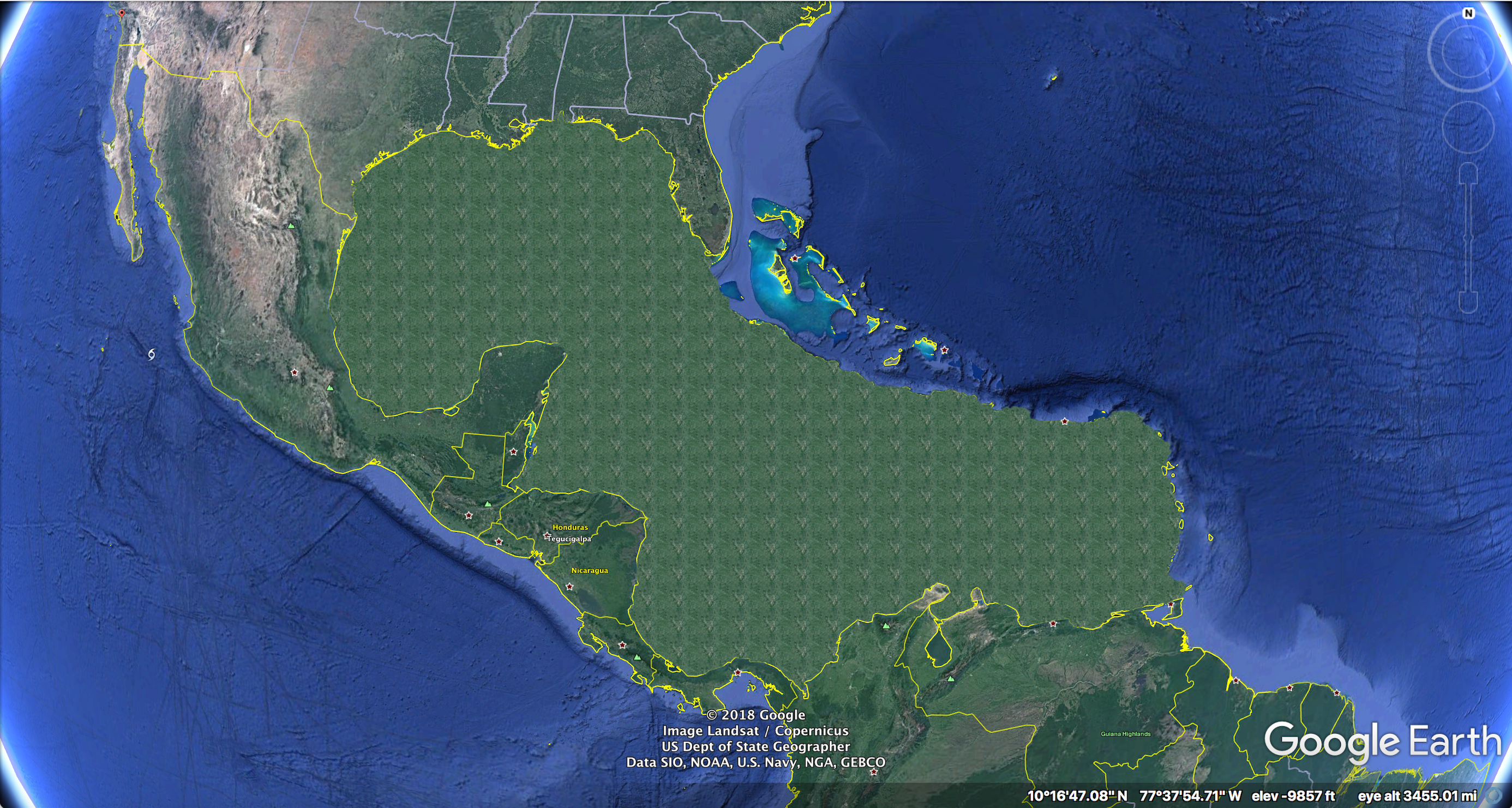
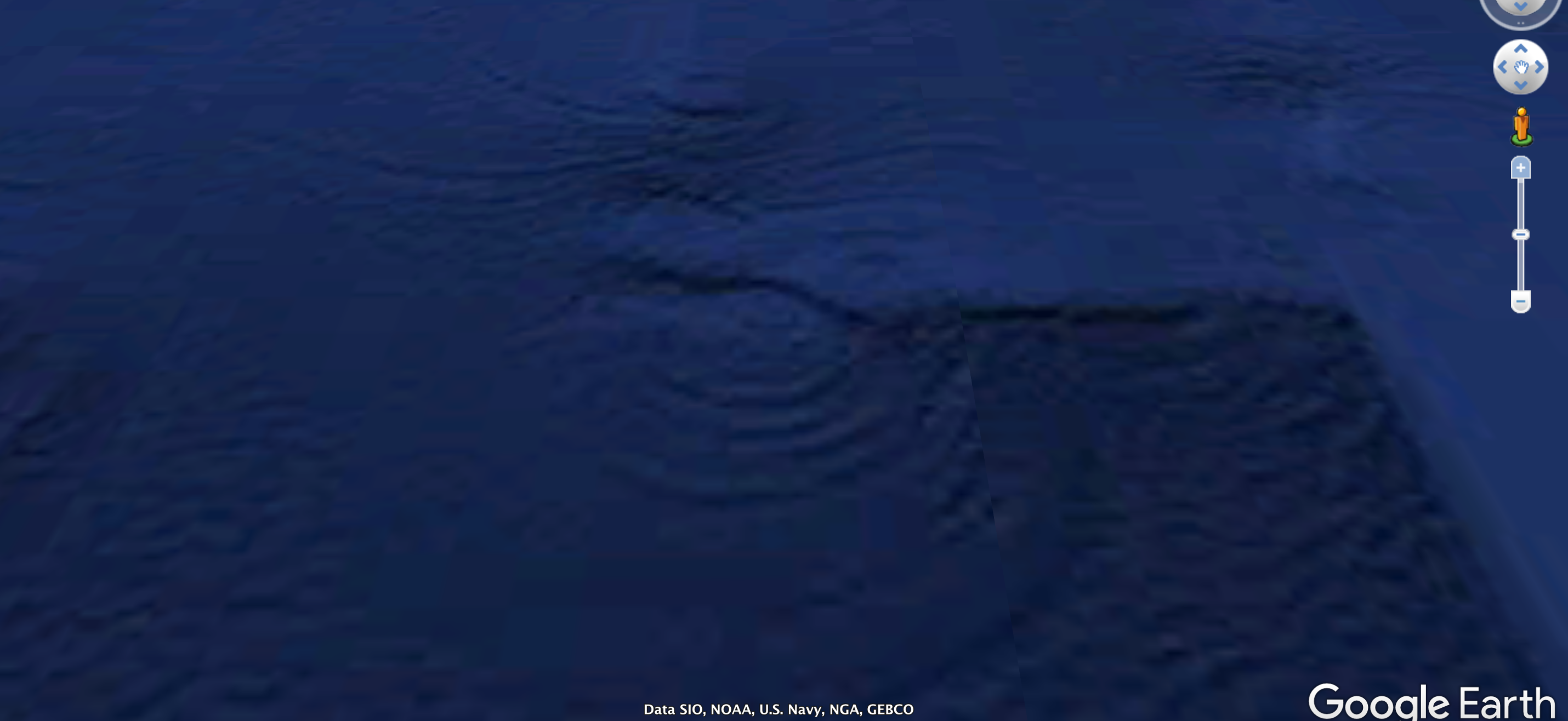
The question that was begged upon the formulation of this hypothesis was whether the seabed of the Caribbean Sea betrayed any evidence of human modification or human existence, for it is the closest thing to certainty that if the Caribbean Sea had existed throughout the entire duration of human civilization, an assumption that has thus far been unquestioned, there should be absolutely no evidence of man-made structures at the bottom of the Caribbean Sea. But upon a thorough examination of the Caribbean seabed, using the visual information compiled by Google Earth's ocean floor viewer, I found what I believe to be evidence of features whose origin is incontrovertibly the work of man, evidence which thus establishes the recent formation of the Caribbean Sea as a matter of scientific fact.

SOLON
By J.P. Yoon
Critias. The mystery of Atlantis is inseparable from that of America. We must not lose sight of the fact that America once was a place that the Old World believed to be a mythical land, and that it was only 500 years ago that this New World first entered the collective consciousness of the Old. As the new millennium has dawned, when America has become the home of hundreds of millions of souls, of diverse origin, unfamiliar and mysterious only to inhabitants of the most primitive and remote cultures of the world, Atlantis remains a mysterious and shadowy realm for all. When the enigma of Atlantis is, at long last, resolved, the final chapter of the Age of Exploration that began in 1492 will have been written, but the opening chapters of a new age will begin.
Until the day that he died, Christopher Columbus believed that he had discovered a westward sea route to Asia; indeed, India to be particular. It was, of course, not until some thirty years later that a European ship sailing westward reached Asia, namely during Ferdinand Magellan’s circumnavigation of the Earth. Columbus’ disorientation can be readily forgiven, and notwithstanding the very first discovers’ confusion, Europeans of his generation and immediately thereafter came to their sense quickly. We credit Columbus for discovering the New World, but not so for recognizing the true nature of even his own monumental achievements, these honors devolving to Columbus’ Italian contemporary and countryman Amerigo Vespucci.
I say that Atlantis, like America, has already been discovered for five hundred years, and that since that time, man has been sailing over its watery grave in ever larger numbers. For the real voyage of discovery consists not in seeking new lands, but in seeing with new eyes.
Solon. We can assume that presently, much of the island of Atlantis is submerged beneath the depths of the Atlantic Ocean. Said another way, much of the island-continent of Atlantis is presently situated below sea level. Prior to its destruction, Atlantis was obviously not submerged beneath the Atlantic Ocean nor any water for that matter, for it goes almost without saying that if it had indeed been so, no civilization could have taken root there, as many by his very nature dwells on dry land and not water. So it must have been the case that the destruction of Atlantis involved, in some way or another, a dry island-continent becoming submerged by the Atlantic Ocean. I contend that there has been an assumption made by researchers of Atlantis, skeptics and believers alike, that Atlantis was, in addition to necessarily not being underwater prior to its destruction, was also above sea level, thus conflating being not underwater and being above sea level. If Atlantis was, before its destruction, indeed above sea level, then the fact that it is now below sea level compels one to conclude its submergence and destruction involved either the island-continent of Atlantis sinking, the sea level of the Atlantic Ocean rising, or a combination of these two processes.
It is here that an impasse has been reached, for modern geology has all but proven that large island-continents of the size of the putative Atlantis cannot undergo appreciable vertical displacements neither upwards nor downwards in the course of a single day and night nor did the sea level rise, even at the end of the last ice, which is when Atlantis was said to have disappeared, occur in the sudden and extreme manner in it had to have done so in order to lead to Atlantis becoming submerged. Faced with these sobering conclusions, scientists have long since ceased to entertain the geological possibility of Plato’s Atlantis account as literally interpreted, and have, for the most part, either revised some of the information so as to permit a more mundane or figurative interpretation, an example being the supposition that Plato obtained his inspiration for the story from the destruction of Thera or Santorini some 900 years before his time.
But what if the assumption that I mentioned earlier, namely that Atlantis was, prior to its submergence, above sea level, is wrong, and contrariwise, Atlantis, just as it is below sea level today, was below sea level before its destruction, and throughout the entire duration of the existence of the Atlantean civilization?
Aristotle. But how could this be? If it was below sea level even prior to its destruction, how could it have had dry land enough for a civilization to have existed on it?
Solon. That is a valid point, which I will promptly address, hopefully to your full satisfaction. You are aware of the existence of multiple places on Earth, a few in most every continent, that are situated below sea level but are nonetheless not submerged beneath an ocean, are you not?
Aristotle. Now that you mention it, it is beyond question. In fact, if I am not mistaken, Badwater dry lake in Death Valley is an example of such a place, as is the Dead Sea, the latter which I believe is the deepest such point on the face of the earth. The reason why I didn’t see this earlier was because our conversation thus far on the subject of Atlantis conjured an image of a huge continental-size expanse of land that was below sea level as opposed to small patches of land.
Critias. What you, Solon, have just now said about people assuming that Atlantis was before its destruction above sea level seems to be an astute observation, and a true one at that, for Aristotle at first, even armed with the knowledge that there exist today many lands below sea level not covered with seawater, did not count Atlantis as possibly being among such lands prior to its submergence. Indeed, I have no reservations in admitting that my thought process was nearly the same as that of Aristotle. I wonder why it is that both of us, whenever we hear the word “island” or “continent,” without further thought, immediately assumed that the island is above sea level.
Solon. I suppose it is because man is a creature of habit, this truism being nowhere more evident than in what we see with our own eyes in the world around us. By this, I mean that since essentially all island-continents that exist today are located, either in part or in whole, above sea level, we without thinking much of it assume that a hypothetical island-continent, if it once existed in the past, must have been so as well.
Aristotle. Yes, yes, it is all a matter of degree, I see. If Atlantis was indeed as we have just supposed, it would furnish merely a vastly larger scale instance of any old below sea level expanse of land. Although I would be surprised for such a giant expanse of land to have once existed below sea level, there is no longer a shadow of a doubt in my mind as to its possibility. Solon. Splendid. Since I have spoken quite a lot and made the introductions, I will yield my role as a speaker and take up one of a listener. Let us continue.
If my memory has not yet failed me, the plain alone of the island-continent of Atlantis was 2000 stadia in one direction and 3000 in the other, which is equivalent to 227 miles and 341 miles in our measurement units, respectively, with their relative proportion being 8.8 stadia to a mile. We also know from Plato’s account that the said plain was surrounded by mountains of great size and height, these mountains descending precipitously to the sea.
As for the possibility of Atlantis being situated below sea level, are we speaking of the plain alone, either in part or its whole, or the surrounding mountains as well?
Critias. I don’t know much about geography, but it is plain to me that if any part of Atlantis was indeed below sea level, then it could have only been the plain alone, either in part or in whole, and that no part of its surrounding mountains, not even the smallest part, could have been below sea level.
Aristotle. I do not see how the conclusion necessarily follows from the premise. If some part of Atlantis was, even prior to its destruction, below sea level, why must the entirety of its surrounding mountains have been, to the contrary, above sea level? Specifically, why couldn’t even the slightest part of the mountains surrounding the plain dip below sea level? The notion of a plain being entirely or mostly below sea level and its surrounding mountains being entirely above sea level evokes a particularly symmetric form that is in its aesthetic flavor highly appealing, and I wonder if we are not letting the doctrine of the Platonic forms get the better of us?
Critias. An image flashed before my mind’s eye. Let me immediately begin my argument for I fear I may not retain it otherwise. First, I must ask you whether you agree that the plain was, prior to the destruction of the island-continent of Atlantis and as described by Plato, not covered by water but to the contrary dry.
Aristotle. Certainly. For it was the plain that was the very nerve center of the civilization of Atlantis, and this is evident from it having been divided into sixty-thousand military and administrative lots. It is preposterous even to suggest that the plain, even before the destruction of Atlantis as a whole, was submerged in even a foot of water, let alone by water of a depth greater than a man’s height, for if it was, nobody could have lived there. This argument Solon mentioned earlier in our conversation, and I agree with both of you and him without any reservation that man, even at 500 generations before the present and yet before that, which is when Atlantis was said to have existed, made the seat of his great cities and his hearth on firm and dry land. I firmly believe that neither then nor now did man actually live on the face of the waters.
Critias. Now if the plain was either in whole or in part below sea level prior to the catastrophe that caused the land of Atlantis to become submerged, and there was, say, one and only one part of the surrounding mountains that was, like the plain, below sea level, then since we know from Plato’s account that the mountains surrounding the plain rose out of the sea, we also know that the mountains, comprising the outer fringes of the island-continent itself, were themselves surrounded by the sea. Then, if any part of the mountains was lower than the level of the sea surrounding them, seawater from the Atlantic Ocean would immediately begin to flow through these conduits along the mountain range and into the plain below, this flow being a natural consequence of the truism that water, if it can do so, flows from higher places to lower places. And it is plain to see that since a plain below sea level is lower than a place that is at sea level, and also that the plain is, by hypothesis, below sea level and the Atlantic Ocean of course, by definition, is at sea level, water from the Atlantic Ocean, being higher than the plain, would flow into the plain.
Aristotle. Since you have done the heavy lifting for me, I can readily see how your line of argument reaches a contradiction.
Critias. Thus, we have established on a firm foundation that if the plain of Atlantis, so emphatically mentioned in Plato’s dialogues, had been below sea level, then its surrounding mountains must have been uniformly above sea level for the plain to have remained dry, and hence at least potentially habitable. In other words, the premise that the mountains surrounding the plain be uniformly above sea level is a necessary one for its conclusion to hold, for it has amply been demonstrated that if it is not satisfied, then neither will be the conclusion. But are we also able to say that if this particular premise is, in the affirmative, satisfied, then so will the conclusion? In other words, of the plain of Atlantis had been below sea level, and the mountains encircling it were indeed uniformly above sea level, does it follow that the plain would have remained dry, and hence at least potentially habitable?
Aristotle. Though I am far from certain, it seems to me that the premise mentioned indeed is sufficient in addition to being necessary for the plain to have remained dry, for if the mountains encircling the plain were everywhere in excess of sea level, the waters of the Atlantic Ocean, try as they might, could not ever reach, at least not by a direct channel of water flowing under the natural influence of gravity, the plain since along all possible paths between the plain and the ocean above, the ocean would have to flow upwards along a portion of all such imaginary possible paths, this being true precisely because the mountain range at all points is above sea level. It being a self-evident truth, in my view, that for the seawater to flow downwards from the mountainous regions to the plain, it must first have flowed upwards from the ocean to the mountainous regions on the range’s seaward side, for if it didn’t then there wouldn’t be any seawater to flow down into the plain in the first place; in other words, the latter having taken place is a necessary condition for the former to have even a possibility of taking place, and also that this aforementioned necessary condition cannot naturally be satisfied, for seawater, like all bodies of water, flow naturally downhill and never uphill, the corresponding conclusion, namely seawater flowing downward from the mountains to the plains, can never be satisfied.
This is not to say that no water of any kind can flow into the plain from these mountains that encircle it and are uniformly elevated above sea level. It has only been shown that ocean water from the Atlantic Ocean will not naturally, in the form of a channelized flow subject to a driving force of gravity alone, flow into the plain. Other sources of water, such as precipitation over the said mountains, even where the precipitation has its source as the ocean itself, specifically that portion of it that falls on the side of the inland side of the mountain range as opposed to its coastal side, are not disallowed from contributing to the river flow from the mountains down into the plain below. In other words, I believe the condition to be both necessary, as was demonstrated earlier, and sufficient, as I believe I have done here.
Critias. I see you have described the interior portion of this island-continent as being an isolated watershed. I cannot find any point of objection to your argument, and consider it wholly sound, save for the added consideration that there must be an excess of evaporation relative to the sum of precipitation and inflow from rivers over this isolated drainage catchment. I wholly agree that if there was indeed such an excess maintained year-in and year-out, the plain at the lowest part of the isolated watershed you have spoken of could have remained dry. And this excess of evaporation, or deficiency of precipitation, is hinted at by Plato’s description of the Atlanteans as having constructed an enormous system of interconnected canals for the purpose of irrigating their agricultural fields, and it is doubtful that they would have invested such a massive effort to convey water to the plain unless it had been a relatively scarce resource, making it unlikely in my view that there was a superfluity in precipitation. What is your opinion as to Atlantis indeed having been such an island-continent as we have supposed it?
Aristotle. Of all the islands I have visited, most of them admittedly being small, the coast is without exception the lowest part of the island, with the interior being higher. Even when the coast of an island is precipitous and mountainous as we have found that Atlantis might have been, I have found such islands to have even higher land inland. Moreover, if any plain or region of generally flat relief exists on the island, this alone being not in the slightest degree uncommon, it has been to my knowledge found toward and along the coastlines rather than in the interior. It is the arrangement of an island in which its highest part is along the outer circumference and its lowest part to its interior that is particularly vexing to me, and engenders doubt regarding the probability of an island-continent of such staggering size and peculiar morphology, although I do not by any means deny its mere possibility.
But I see very clearly that the below sea level plain of this island-continent, were it to have once existed, could have become submerged in a deluge of truly biblical proportions, for if any part of the mountains that surrounded it, which by necessity must have been above sea level all around in order to have kept the ocean at bay, were somehow reduced to below sea level, through here and down into the plain below , as we have shown earlier, would begin to pour the endless waters of the ocean. I fail to see by what mechanism such a part of the encircling mountain range could be reduced to below sea level, thus allowing the ocean to intrude upon the low-lying interior of this fated isle, but I fail to see by what means such a deluge, having once commenced, could be stayed until it had run its course, for I imagine the inflow of the seawater to be not unlike a raging torrent, its overwhelming power carving out an ever-deeper and wider channel, which in turn would result in a greater amount of water pouring forth and so on, until the level of water above the plain had risen to equal that of the level of the sea, at which point it would hardly be an exaggeration to describe the plain as having become, as Plato told us, swallowed up by the sea.
Critias. My dear friend Aristotle, could not an earthquake be the cause of such an event occurring, namely that of a part of the mountains surrounding the plain being reduced from above to below the level of the sea?
Aristotle. Why yes, Critias. And what is more, the account of Plato affirms that an earthquake, indeed, caused the destruction of Atlantis.
Solon. I believe we have reached a major breakthrough here, for we have arrived at a plausible mechanism by which an island-continent as described by Plato could have become submerged without resorting to an explanation involving the vertical subsidence of the entire islandcontinent as a whole.
Critias. Why of course, Solon, for the mountains that had surrounded the plain and thus kept the waters of the Atlantic Ocean at bay, as we have firmly established, must have been elevated above the level of the sea all around. As Aristotle said, the mountain range that surrounded the plain need have sunk below the level of the sea, due to an earthquake as we have supposed, at only a single point for the waters of the Atlantic Ocean to have completely engulfed the plain, turning it into a sea. That point of original failure, the weakest link of the chain so to speak, as Aristotle so eloquently said, that permitted the Atlantic Ocean to at first trickle down and then pour into the plain, would be eroded by the force of this flowing water into what I imagine would be a deep and broad canyon throughout the course of the deluge. Once the water level in what had formerly been a dry plain but was now a sea undergoing its birth pangs equaled that of the Atlantic Ocean itself, the canyon thus carved out would have become a waterway, perhaps best described as a strait or a passage between the Atlantic Ocean and the newly formed sea, not unlike an umbilical cord holding in communion the waters of the Atlantic mother to her seadaughter. If there had been multiple points of failure along the surrounding mountains, meaning that an earthquake of exceptionally large magnitude or duration, or a combination thereof, had resulted in several points along these mountains sinking below the level of the sea, the waters of the Atlantic Ocean would begin to trickle down into the plain below through not only one, but all of these points where the mountains had sunk below that fateful threshold. The windows of these heavenly mountains, once opened to a sliver, could not be shut, and the fate written in the stars for this inverted isle came to pass. Each point where the mountains had sunk below the level of the sea would grow into a distinct inflow channel, with each such channel becoming greater in depth and breadth as they fed the ravenous appetite of the Atlantic. In the end, these channels thus carved out would have become the waterways connecting the Atlantic Ocean to its newly formed sea, there being one for each place along the surrounding mountains that the earthquake had sunk below the level of the sea. For instance, if this said earthquake had resulted in ten different points along these mountains being sunk to below the level of the sea, then there would be ten waterways connecting the Atlantic Ocean to the sea thus having been created.
And moreover, the parts of what had been the mountains encircling the dry plain that had not been carved down into these ten or however so many waterways would, having been above sea level prior to the earthquake that had transformed the depressed plain into a sea, would therefore remain above the level of the sea. As the plain became a sea, one can clearly see that the mountains surrounding the plain would become an island arc with ten, or however so many, waterways connecting the sea enclosed and rimmed by the island arc to the Atlantic Ocean. To put it simply, before the destruction of this island-continent, it had been in the form of a below sea level plain surrounded by mountains, and afterwards, it was in the form of a sea surrounded by an island arc; the plain had become the sea and the former’s surrounding mountains had become the latter’s surrounding island arc.
Solon. Now we know what to look for to test our hypothesis. If Atlantis was as we have imagined, and was destroyed in the manner we have envisioned, it must be a sea somewhere in the Atlantic Ocean outside the Strait of Gibraltar, thus excluding the Mediterranean Sea that is circumscribed by an island arc separated by at least one, and possibly numerous waterways such as straits or passages.
Aristotle. And if we find such a sea circumscribed by an island arc in the Atlantic Ocean, we may infer, using Critias’ concluding remarks, that this sea and its circumscribing island arc, had once been respectively, the plain and its surrounding mountains, these last two when taken together comprising the island-continent of Atlantis itself, the sea having been formed as we have supposed, namely by means of a deluge.
Now if this plain of Atlantis, that is, prior to it being deluged by its eponymous ocean, had been situated not merely a thousand feet or so below the sea level then, which is already lower than any land existing today save for the Dead Sea of the Holy Land, but more than a mile below it, such a plain would seem to be inimical to human civilization, on account of its excessive temperatures, would it not?
Critias. No, in fact it could have been much deeper, if we are talking about a depth that would be consistent with comfortable temperatures and a genial climate. Here is why. As we have already mentioned, we have been talking about Atlantis as if it were an inverted island-continent so to speak, this referring to the fact that Plato’s account speaks of there being high mountains by the shore of the land and the low plain towards the interior, so as to describe an island-continent of a distinctly concave overall shape, which as we said before, is highly unusual in that most-island continents at least among those that exist today are not concave like this, but to the contrary have their highest parts toward their interior and the lower parts toward the shoreline.
Now this plain of Atlantis, it being surrounded by higher land all around, namely by the mountains we have so often spoken of, could very well be described as a basin in addition to just a plain, for that is the defining property of a basin; for a plain is any low lying and flat expanse of land, but a basin is all that with the added condition that it is surrounded by conspicuously higher land.
And what is peculiar and noteworthy about basins is that their temperature profile, particularly during the summer months, are very frequently reversed or inverted so that their highest temperatures not found at the lowest part of the basin, namely its floor, but instead higher upwards where along the walls of the basin, at the higher ground that surrounds the basin, here being the mountains.
Aristotle. You are speaking of the temperature inversion, no?
Critias. Yes, that is the precise term for the phenomena I was just speaking of.
Aristotle. Well, then, I must admit I presumptuously took the island-continent of Atlantis to exhibit the typical temperature profile, namely with temperature decreasing as one increases in altitude and vice versa, increasing as one goes down, but in light of what you have just said, I am reminded that Atlantis has a peculiar geography as we have agreed upon, this geography indeed making it a distinct possibility that the plain, or basin of the land could have been exceedingly deep, even many miles below sea level, with its summertime temperatures being suitable for mankind, and civilized mankind at that.
Critias. Still, I must commend your apt observation that if there was no such inversion, and the temperatures in fact did decrease with increasing altitude and increase with decreasing altitude, a very deep basin could not be suitable to human civilization due to its sweltering heat. And to my credit, a temperature inversion’s presence makes it possible for the basin or plain to be even arbitrarily deep, perhaps even as deep as parts of the deep ocean floor; at least such a depth cannot be ruled out on account of the temperature being too high, nay, as we have seen it could have been even cooler at those abyssal depths than at the higher surrounding land closer to sea level, which goes against the assumption that such lands must necessarily have been or would be exceedingly hot.
Aristotle. Having established the probability of a temperature inversion in such a plain as we have spoken of, provided that this plain was situated at a depth below sea level equal to the average depth of the Atlantic Ocean, a somewhat arbitrary standard of comparison, and far higher than any land surface ever known to have been exposed to the air and light save for the deepest points of the Mediterranean basin when it was dried out, the sea not yet having been birthed, I hold it a certainty that with regard to the pressure and density of the air in that cavernous depression, there would nevertheless be no inversion so that as one would increase in altitude, the pressure and density of the air would decrease, and vice versa for both.
Critias. I am in full agreement, my friend Aristotle. Now I have estimated that at such a depth of 12,900 feet, which is the reference height you mentioned, the air pressure would be about fifty percent higher than at sea level, as would the density of the air. And since oxygen is a homogeneous gas in the atmosphere, it can be readily known that its partial pressure at such a depth would also be greater by this very same fifty percent. Such a high atmospheric pressure nor density would not be encountered anywhere on Earth’s land surface anywhere today; even the Dead Sea’s atmospheric pressure reaches only six or so percent above the sea level datum pressure. Aristotle, in the topics of physics and meteorology, you are far more informed than I am; how do you think we could begin to guess at what such an environment would be like to man, for none such now exists?
Aristotle. Critias, I had somewhat anticipated your question, for my mind was grappling with the same question. It is almost completely unrelated to the topic at hand, or so it seems, but I thought about hyperbaric chambers, and I think these are the only places where one could experience such a high atmospheric pressure. The difference, of course, being that if the people of Atlantis indeed, at least some of them, lived at such a great depth, they would have been exposed to such a great ambient pressure their entire lives, from birth to death, and not merely for the time that they were placed inside an artificial chamber, as we must make do with now. Now that is a strange thought indeed. Could man even survive in such an environment? I daresay he would not only survive, but thrive. Now, by Henry’s Law, which states that the solubility of a gas in a liquid is directly proportional to the partial pressure of that gas above the liquid, taking the premise that the partial pressure of oxygen was 50% greater than it is at sea level today, then the amount of oxygen dissolved in the blood would increase by that same percent in accordance with this law.
I frame no hypotheses as to how this could be so, but I speculate that man in such an environment could age more slowly and thus live out a greater number of years, for the salubrious effects of even sporadic and intermittent use of a hyperbaric chamber for even what amounts to at most the most inconsequential fraction of a percent of a patient administered hyperbaric therapy are readily evident; I ask for a fair measure of indulgence when I say this, it being out of my character to say something of this nature, but if the benefits of such a highly enriched oxygen atmosphere found in a hyperbaric chamber were experienced for more or less the entirety of the Atlanteans’ lives, being deprived of this blessed air only when ascending to the upper heights and mountains near the sea, or when taking voyages across to the sea to their supposed colonies and outposts, if we are to take the highly esteemed Donnelly’s ideas t heart, the benefits of inspiring such an air would be compounded upon itself over that fortunate race’s lifespan... perhaps to such an extent that the very years of his life would be extended, if not the quantity at least in their quality.
Solon. Now that is a radical proposition indeed. My dear Aristotle, you have come from dismissing the story of your esteemed teacher as categorically fictional to hypothesizing that these invented people of a land that never was were some sort of blessed race akin to the Biblical antediluvians or demigods with respect to their longevity.
Aristotle. We are treading on thin ice, and I wish to listen more than speak, for I have already exceeded my measure of indulgence, I suspect. Let us, therefore, change our subject of conversation to a more mundane one.
Now what do you think of the proposition that our own ancestors, namely the Athenians, inhabited Attica over twelve thousand years before today? For that is when our forefathers were said by Plato to have defeated the mighty invading Atlanteans. Could our race date back to such a vast antiquity?
Critias. If it can be accepted that the Atlanteans existed so long ago, I cannot see why our own ancestors couldn’t have done so as well. At any rate, it seems the more plausible that the Athenians existed then than did the Atlanteans, for at least we know that the land of Attica, regardless of the veracity of Plato’s description thereof, must have existed even twelve millennia ere today, as opposed to Atlantis, of which we are ignorant as to whether even the land existed, let alone its people as described by Plato. And Solon, what is your opinion as to the plausibility of the civilization on the Nile River of Egypt dating back to ten thousand and five hundred years ago, particularly their possessing the knowledge of letters then, of which traditional chronology has assigned to a much later date, some five thousand years afterward? Are you not inclined to disbelieve that the chroniclers and historians of the Egyptians themselves, at least those today, disclaim such a high antiquity for their civilization, and that it is, to the contrary, the outsiders and foreigners who insist otherwise?
Solon. I admit it is strange that the Egyptians themselves do not claim their civilization dates back to 8500 BC. Speaking from what is reasonable, we would expect the Egyptians themselves to vouch most adamantly for such claims if they were indeed that old, for it is a matter of honor for all nations to be recognized as the eldest, as it is among siblings. But I think there may yet be another reason to account for and plausibly resolve this seeming contradiction. For you see, since the time I visited Egypt 2500 years ago, she has been conquered by a succession of great empires, namely the Persian Empire, the Empire of Alexander, Islamic and Ottoman, and British empires, and it being a truism that history is written by the victors, the Egyptians having been the vanquished, may very well have forgotten their own history, either through the lapsing of the labors of the priestly class or a suppression of their true history in favor of the new and successive ruling authorities.
We have seen such efforts to rewrite or revise history on the part of many new conquerors for various purposes, for instance the Spanish conquistadores; the many works and written records and literature of the Maya were desecrated and burned under the pain of death. History thus passed into myth, and the priests of the old religion were, under pain of torture and death, compelled to convert to the one true faith. It is only recently that the Maya have begun to recover their written records of old, and so much of it has been irrevocably lost that we may be able to see only the tip of the iceberg of the full antiquity of their civilization, and likewise the Egyptians may be afflicted with a similar bout of historical amnesia for analogous reasons.
As for ourselves, if Plato’s account is correct, even more has been lost, for while the Egyptian priesthood fell under a period of slow and prolonged decay, the lettered of our supposed forefathers were, according to Plato, wiped out in a single fateful day and night by what the most learned of the priests of the city sacred to Neith said to be the greatest of all floods and massive earthquakes. If we are to reconstruct our own past to more than several centuries prior to the Trojan War, of which we now are bereft of knowledge and in a state of abject ignorance, then it would be ill-advised to be closed-minded on that subject, as ignorance coupled with closed-mindedness tends to mutually perpetuate each other in a vicious circle.
Critias. No truer words than yours could have been spoken, my dear Solon. Wouldn’t it be marvelous if the city of Athens, not once but twice, repelled an invasion of an aggressive empire that had prior to meeting its nemesis known nothing but victory? If it be true that history repeats itself, perhaps it is not so preposterous that our forefathers of 9600 BC halted the armies of a great empire, much as our own grandfathers did to the Persians.
Of course, for the Athenians to have fought the Atlanteans at such a distant past, the Athenians must have existed. Let us delve into the account of Atlantis that bears my own name, and the part thereof concerning the ways of life of these Athenians in particular, in order that we may discern the plausibility of their having existed as reported…I shall waste no further time with idle discourse and will mention a passage in the Critias that I, at first glance deemed fit to ignore, but now, upon further reflection, believe warrants serious attention. This passage says of these Athenians that they, having made the ancient Acropolis their residence, lived on its northern side during the winter and on its southern side during the summer, moving back and forth alternately with the passing of the seasons.
Aristotle. I was pondering that same question. It is indeed a mode of life that is quite unusual compared with our own traditions and ways of life. Though I hesitate to make any sweeping generalizations, I do hold the belief that all traditions and ways of life have at their root some advantage to the survival of the individual and of the society in which lives. In our enlightened age, relatively speaking, the base requirements for material existence having been secured against the whims and terrors of nature by the development of civilization through the long ages, our particular mode of living is be directed chiefly at increasing the comforts of life more so than securing survival. I also maintain that it is the nature of man to wish to minimize the variation in his environment as far as his ingenuity, technology, and capacity admit. This is perhaps the chief reason as to why, for example, properties of lands lying on the coast of the Mediterranean Sea, all other factors equal, fetch higher values than those farther inland; the moderating influence of the sea, in making summers cooler and winters warmer close to the sea and thereby reducing the swings in temperature over the course of a year, enhances the desirability of coastal lands relative to inland regions. I hold that if man, somehow, could attain the means to control his environment at will, he would make it unchanging and constant with the passage of time, at least once he made up his mind on what his ideal environment was.
Critias. Are you suggesting that the Athenians of old migrated from the northern side of the Acropolis in the winter to its southern side in the summer so as to minimize the effect of the changing seasons?
Aristotle. Precisely. Though the age to which these Athenians belongs to is supposedly 9000 years prior to the time of Solon, and thus 11,600 years before the present day, one can safely assume that much as today, the northern face of a hill located in the Northern hemisphere during the summer months, by virtue of the hill obstructing the rays of the sun, provided a measure of comfort and shade from the heat; likewise, the south side of that same hill during the winter months, this side being directly exposed to the rays of the sun, would provide warmth.
Critias. That is an eminently plausible explanation as to why the Athenians of the remote past could have partaken in such seasonal migrations, but there seems to be a glaring flaw in it that contradicts your postulated general principle that man endeavors to secure his living arrangements so as to minimize the extremes and variation in his climate and environment. It is that the Athenians, as accounted by Plato, lived on the north side of the Acropolis not during the summer, as you said just now, but during the winter, whereas they lived on the south side of the Acropolis not during the winter, again as you said, but during the summer. This mode of living, as Plato actually wrote down, would have resulted in their being exposed to greater temperature variation over the course of the year than if they had simply stayed put on a single side of the Acropolis throughout the entire year, would they not?
Aristotle. Now that is quite interesting, and I fear, a penetrating observation and a fatal one to boot. You are correct, Critias, that in Plato’s narrative, the Athenians do indeed migrate in such a way that they would be exposed to greater rather than lesser temperature variation over the course of a year, and you are also correct that this mode of seasonal migration contradicts my earlier stated principle that man seeks to minimize environmental change. Still, I am reluctant to discard this principle altogether, and I am inclined to maintain that the manner of living of these Athenians is but an exception, to a general rule that still has merit.
But if the rule stands, and the Athenians actually lived as Plato said, their mode of living would be not a minor, but an egregious exception to the supposed rule that man seeks to structure his life so as to minimize the effects of a natural variation in his environmental conditions. To seek direct sunlight, a source of heat, when suffering an already sweltering summer, and to avoid it in the winter of its direst need, as the Athenians were indeed described as doing, would be not unlike inhabitants of modern Athens turning on the heater during the summer and the air conditioning during the winter.
Critias. That is all indisputable, Aristotle. I too recoil at abandoning the rule that you set forth, for it seems to capture an aspect of human nature that would be as true for our forgotten ancestors of 9000 years ago as it is for us today. I do sincerely wish that your beautiful theory, Aristotle, be not slain by my ugly fact, and with that purpose in mind, let us together put forth an effort to salvage it.
Aristotle. In order to make any further progress in that direction, we must investigate the nature of the source from which Plato’s narrative has come down to us in its final form. Critias, with no intent to slight your contributions to our discourse, I see no recourse save deferring to our elder Solon, the awakening from its slumber of this whole controversy concerning events of an age so far removed from our own is to be attributed solely to him, at least in the world of the Greeks.
Critias. Of course.
Solon. We must also remember that 9000 years before my visit to the land of the Nile, which was undertaken in the early 6th century BC, was when the war between Atlantis and our own all but forgotten Athenian ancestors was said to have taken place by the most learned of the priests of Sais. This war, as I was told, and is written by the hand of Plato, was fought at nearly the close of the kingdom of Atlantis and the firstborn Athenians, for it was told that the great cataclysm that wiped out any trace of memory of these ancient peoples struck not long afterward. As far back in time as 9000 years before my visit to the city of Sais is, that date was to the Atlanteans and Athenians their golden years, so to speak, and though it is in all likelihood beyond our means to fix a date of birth of either of these civilizations, the highly sophisticated heights to which both of these cultures had attained to suggests that the they had an extensive developmental time, more likely in the range of a few millennia than, say, only a few centuries.
Aristotle. And this is quite reasonable, for it is known that the beginnings of the Ancient Egypt, even if the traditional chronology is correct, dates back to around 3500 BC, and what is more, that they maintained their unique form of pharaonic kingship for a duration of three millennia, suffering interruption only for brief intervals of time, when foreign rulers held sway over them, and always repelling the interlopers to restore native rule. It was only with the coming of the Persians and then the Macedonians under Alexander, and finally the legions of Rome that Egypt at last came to submit to foreign domination as a rule rather than as an exception. I hold it not unreasonable to assign to the Egyptian civilization a duration of, as a lower bound, three millennia.
Critias. And so it would not require a suspension of our belief to assign a duration of three millennia to the Athenian civilization that defeated the Atlantean invasion 11,600 years ago, it seems.
Solon. Yes. Let us suppose that three millennia were, indeed, the duration of the first Athenian civilization. Then, the Athenians would have established the roots of their civilization around 12,000 years prior to my travels in Egypt.
Critias. Pardon my interruption, but 12,000 years is just about half of 26,000 years.
Aristotle. Now Critias, what does this fact have anything whatsoever to do with our present subject of discourse? And what is so special about the number 26,000? I have just about run out of patience with those who reflexively assign hidden meanings to numbers.
Critias. Please take my word for it when I affirm that I am not as far gone as, say, the Pythagoreans, who see in numbers the meaning of life and the universe. Sometimes a number is just that, a number; indeed, there is nothing particularly interesting about the number 26,000 itself. It is the number 26,000 in conjunction with the year that I suspect may be relevant to resolving our paradox, namely the question as to why the ancient Athenians sought out the light of the sun precisely when it would have been the greatest curse, and avoided it when it would have been the greatest blessing.
Solon. I am just as confused as Aristotle seems to be, my dear Critias.
Critias. 26,000 years, as was divined by the esteemed Hipparchus of Nicaea, is the interval of time in which the Earth undergoes one complete cycle in what is known as the precession of the equinoxes. And it is a fact that if two points in time on the same calendar date are separated by half of a full precessional cycle, that the actual seasons corresponding to these two points in time will be exactly out of phase with each other, that is, opposite to each other. For example, and this applies only to places in the Northern hemisphere), in the present day, our July is what we call summer. But 13,000 years in the future, and also 13,000 years ago, the month of July would have been what we call winter.
This process occurs so slowly that the ever-growing deviation of the sky on one hand, and the calendar on the other, would in all likelihood go unnoticed unless systematic and thorough observations were made over periods significantly longer than a human lifetime. And not too unexpectedly, the precession of the equinoxes was not definitively discovered before Hipparchus in 127 BC. History has shown that it is not a given that recognition of the phenomena of precession as a real phenomenon by a civilization would necessarily result in its calendar being modified so as to correct for it. In fact, Babylonian, Assyrian, Chinese, and Maya, and Egyptian astronomers, advanced as they were in their knowledge of the stars, insofar as history tells us, never saw as far as Hipparchus.
Solon. And so since my travels to Egypt, having taken place in the early 6th century BC, antedate the discovery of precession by Hipparchus, it naturally follows that the Egyptian priests and scholars with whom I conversed could not have known about it, and hence wouldn’t have corrected for the slow deviation between the calendar and the seasons corresponding to the calendar.
Critias. Quite right.
Aristotle. I wish to clarify a point. The Egyptian astronomers and priestly class, if I am not mistaken, spared no labors in observing the stars, and as is common knowledge, conducted such observations over a very long period of time by virtue of their surpassing longevity. Though I do not reproach the Egyptians in their love for knowledge for its own sake, it is surely not a misstatement to attribute the Egyptian’s keen interest in the sky and the stars, at least in part, to necessity. What I speak of, as you may have groped at, is the annual flooding of the Nile River. I do not pretend to speak for a people of whom I am acquainted with only secondhand, but I estimate it is likely that the date when the flooding of the Nile commenced each year was among their most important dates, and thus it would be expected that the slowly changing calendar date of its occurrence, this change of course being the consequence of the Egyptians having established their calendar without knowledge of the precession of the equinoxes, would have been noticeable over the centuries upon centuries that passed by.
Solon. And the Egyptians indeed did notice this change, and this can be amply demonstrated by the historical record; they recorded and made explicit note of this change. In fact, they did so long before Hipparchus discovered the precession of the equinoxes.
Aristotle. That is precisely the point I wish to clarify. If the Egyptians noticed the drifting of the calendar date of the flooding of the Nile, as you said they did, and before Hipparchus at that, then why do we not give them the credit for discovering the phenomenon of precession of the equinoxes?
Solon. That is a good question, and the answer is that the Egyptians, unlike Hipparchus, though they noticed and recorded the fact that the date of the flooding of the Nile changed with the passage of time, they failed in noticing that this deviation of the occurrence of events with respect to their calendar extended also to astronomical phenomena in the most general sense, rather than being, as they thought, limited solely to earthly events, such as the annual flooding of the Nile, or only individual stars in the sky.
Now, by a remarkable coincidence of causes that the Egyptians could not understand the cause of, the rising of Sirius, the brightest star in the night sky, on the eastern horizon for the first time in any given year, which in astronomical parlance is called the heliacal rising of Sirius, occurs in such a way that over the course of 1,460 years, or a Sothic cycle, the 365 day Egyptian calendar would lose enough time so that the start of a year corresponded once more with the heliacal rising of Sirius.
Where the Egyptians failed to make the next intellectual leap was in placing such a predominant emphasis on a single star, that is, they failed to see the forest (of stars) for a star. In order for the Egyptians to successfully measure the period of the precessional cycle of the Earth, it would have been necessary to make the identical observation for a star in the zodiac as was made for the star Sirius (which is not close to the zodiac); that is, the period of the heliacal rising of a star in the zodiac would give the period of precession.
Perhaps the discovery of Hipparchus can be attributed to blind luck, in that he chose to observe a star in the zodiac named Spica, in the constellation of Virgo, to conduct his measurements. Aristotle. So it can be said, then, that the Egyptians, though they were aware of the Sothic cycle of the heliacal rising of Sirius, having a period of 1,460 years, they were unaware of the more general precessional cycle of 26,000 years?
Solon. Yes, that accurately sums up the state of their knowledge.
Critias. Now let us put ourselves in the shoes of the Athenians, say, who lived 12,000 years prior to Solon’s visit to Egypt, taking his narrative as factual, and not as a work of inspired imagination. Now it should be said that the Egyptian months numbered twelve, just as in the Julian and Gregorian calendar, and moreover, that the Egyptians gave unique names to each month, also as we do today.
Suppose that the Egyptians who put the observation of the Athenians seasonal migrations down in writing referred to what were their summer months with a representative month, such as their month corresponding with our June, and also, that they referred to what were their winter months then with one of their representative months, such as the month corresponding with our December. So in that case, the Egyptian written record pertaining to the Athenians’ seasonal migrations would read as follows: “During the month of January, the Athenians lived on the north side of the Acropolis, and during the month of June, they took up residence on the south side of the Acropolis.” Now the Egyptians, when they translated their hieroglyphics corresponding to these month names to Greek in order that the story of Atlantis should be told to Solon could have and in all likelihood would have translated their month corresponding to our January as simply “winter,” and likewise, their month corresponding to our June as simply “summer.” To a culture with no definitive knowledge of precession and the consequences it had on the seasons correspondence with the named calendar months, it would never come to them to entertain the possibility that their month corresponding to our January was not a winter season, or similarly, the possibility that their month corresponding to our June was not a summer season.
But if the account that the Egyptian priests communicated and translated to Solon truly contained observations of the Athenians’ seasonal migrations that were made pertaining to the Athenians’ lives as they lived up to perhaps 12,000 years ago, with the written records themselves being written slightly later, at 8,000 years before the time of Solon’s visit to Egypt, then the names of the months they wrote down in the record would have been written down long enough before the time when the priests of Egypt told Solon the story that the inscription for January that the priest translated into winter would have actually been a summer season in the distant past when the Egyptians had made their observations of the Athenians. In other words, if it be true that the record truly dates back to such a vast antiquity, the very meaning of a month-name such as January, would have changed; by the effects of a precession that they did not know of, the original priests who composed the record would have meant by “January” what we call “summer,” but due to the passage of time comparable with one-half of a complete precessional cycle between then and when the priests translated the record to Solon, “January” had come to fall in the part of the year that we call “winter.” The priests in 600 BC made an assumption that the month-name January, it referring to a winter month in their own time, referred to a winter month at most all times in the past and in the future. They could not have known, but we can now reason, employing our present astronomical knowledge and also the documented history as well as calendar of Egypt, that such an assumption would be most wrong if the record that they were translating had recorded events that happened close to 13,000 years earlier.
If the Egyptians who told Solon the tale of his long-forgotten Athenian ancestors had known of the reversal of the seasons that takes place every half-precession cycle, then this knowledge in addition to their knowledge that the written records of that story were of comparable age as a half-precession cycle, they would have seen the necessity of translating the written record pertaining to the Athenians’ seasonal migrations, which read: “During the month of January, the Athenians lived on the north side of the Acropolis, and during the month of June, they took up residence on the south side of the Acropolis,” not as “During the winter, the Athenians lived on the north side of the Acropolis, and during the summer, they took up residence on the south side of the Acropolis,” which presents the glaring contradiction we have thus far been attempting to resolve, but rather, as “During the month of January, which was to the Athenians a summer season, the Athenians lived on the north side of the Acropolis, and during the month of June, which was to the Athenians a winter season, they took up residence on the south side of the Acropolis,” which would resolve the contradiction, for living in such a manner with the passage of the seasons would be explained by their desire to escape the sunlight when it was hot, and seek it when it was cold, which is a more primitive form of turning on the air-conditioning when it is hot and the heater when it is cold, but essentially with the same motive, to seek comfort from the extremes of the elements by moderating them.
Thus, I have satisfactorily demonstrated, I hope, that it is entirely consistent, that the written records of the Egyptians pertaining to Atlantis and Athens, if they indeed existed and were not just a literary device, date to such a vast antiquity.
Critias. Now, we have been discussing Atlantis as a place possibly far below sea level. Now, if I may take a measure of indulgence myself, in that area of metaphor and myth, could it not be that such a place, if it indeed once exited, could be fairly described as an underworld?
An underworld not below our feet and subterranean, as the myth has thus far been interpreted but a world, situated below the land of other words, in such a conspicuous manner as to merit the name underworld, for certainty an Atlantis as we have imagined befits such a designation. I think it not impossible that a plain, or yet, a basin situated over ten thousand feet below the level of the sea, and the size of Libya and Asia Minor combined, as was said by Plato, could not be aptly named an Underworld, or I daresay, and here is where I ask for my fair measure of indulgence, The Underworld of our sacred myths, that is, Hades herself? I recall that Homer spoke of the Underworld being at the far confines of Oceanus, which I take to mean the western shores of the Atlantic Ocean. If we are to reason along such lines, then we should look for Atlantis on the far west of the Atlantic Ocean rather than in its middle, as Donnelly and many others have proposed, or just in the front of the Pillars of Heracles. As for myself, these will be my closing remarks, and I yield to our elder, the wisest of the Seven Sages, Solon.
Solon. I will say my last words by recounting another tale; this I have received not from the land of the Nile Delta in the city sacred to Neith, but thousands of miles to the west, but an island, as Homer alluded to the Underworld, close to the far confines of Oceanus from the standpoint of the Pillars of Heracles. Keep in mind the symbolism of the gourd as I tell it, especially its shape, and what happens to it as the story goes on. If you have paid close watch whilst we have conversed thus far, and do the same in the story I will tell now, you should be able to unravel the true nature of Atlantis, especially its plain, both prior to its submerging and afterward, for they together, as well as Plato’s dialogues, will furnish a sufficiency of clues as to this hitherto perplexing riddle. And do not despair, my friends, for I have found the capital city, it being surrounded by the very plain Plato spoke of, and the number and radii of the concentric circles therein establish that it is indeed the lost city of Atlantis.
I hereby present you to the story of the Taino people, who are native to the island of Hispaniola and say that they were “born in the caves” of that island, meaning that they do not recall a time when their native land was ever not their home.
In the beginning of time, before the land was surrounded by sea, in a place called Zuania (South America), there stood four great mountains. One of these mountains was called Boriquen, Land of Brave Men. In the village of Coabey on the side of that mountain lived an old man, Yaya, with his wife, Itiba, and their only son, Yayael. Yayael was a skilled hunter.
Yayael hunted with a bow his father had carved from tabonuco wood. It is said that the tabonuco tree is the home of spirits and that its wood holds magic power. This may be true, because when Yayael hunted he always brought back game. The people of Coabey ate well, even when hunters from other villages came back empty-handed.
While hunting one day, Yayael noticed that the sky darkened in the east. Then a flock of swallows flew before the lowering clouds and circled low around his head, flapping and beating their wings. Yayael knew this was a warning that Guabancex, the terrible goddess of hurricanes, had awoken and was angry at Yayael’s magical hunting success. She was coming to take revenge. Yayael quickly hid his bow and remaining arrows under a large rock and ran toward the village, hoping to reach safety before the screeching winds and pelting rain overtook him.
Guabancex struck with tremendous force. Winds raged for hours. Trees that had stood for all time were uprooted and tossed aside like kindling. Every house in the village was ripped apart and flattened. The villagers had been working in their fields when the hurricane struck and sought shelter in a cave. When the winds died to a moan and a whimper, the people ventured from the cave to find their village destroyed. Yaya and Itiba waited for Yayael to return, but Yayael did not appear.
Yaya went to search for his son. He found the bow and arrows where Yayael hid them, but no trace of Yayael could be found. When Itiba saw her husband return with their son’s hunting bow, she screamed out Yayael’s name and fell down weeping at Yaya’s feet. Yaya reverently placed Yayael’s bow and arrows in a large gourd and sat down beside his wife and wept with her.
The villagers helped one another rebuild the village. When the time for grieving was over, they helped Yaya and Itiba hang the gourd from the ceiling of their hut. There the bow would be safe, just in case Yayael’s spirit should wish to visit them. Yaya and the other village men picked up their bows and trudged out the hunt, since they could no longer count on Yayael to bring home the meat to feed the village. Though the men hunted every day, they never brought home enough. All were hungry. Even the children, who were always fed first, became thin and sickly. In desperation one evening, Yaya asked Itiba to lower the gourd that held Yayael’s weapons. “I want to see our son’s bow,” he said. “Perhaps it still holds some power of the tabunoco.”
As Itiba lowered the gourd to the floor, it tipped just a little. Out splashed many plump fish. Yaya and Itiba were astonished. They had never before seen such fish - large and silvery and still breathing, as if freshly pulled from a stream - but bigger, plumper, and unlike any fish that ever swam in the stream or rivers of their land. Itiba cooked the fish and invited the whole village to share the meal. The villagers rejoiced in their good fortune and sang “Bahari Yayael!” (“We honor you, Yayael!”) and they went to bed with fully, happy stomachs for the first time in weeks.
The next day the villagers marched out to work in the fields. They left four boys to guard the gourd with Yayael’s bow and arrow that Itiba had re-hung from the ceiling of his hut. But the boys soon grew curious and hungry. The higher the sun climbed, the hungrier and more curious they became. One boy stood on his tiptoe and tried to peer into the gourd. Then a second tried to climb up to see inside. Together the four boys climbed, and tugged, and brought the gourd down to the floor.
Out flopped four beautiful fish - just the right size for four hungry boys. The boys cooked and ate the fish. Then they ate four more. Then, singing praises to Yayael, they ate yet fur more. Now happily stuffed, they fell asleep.
The boys awoke to the sounds of the villagers returning from the fields. Afraid of being caught, they hurried to re-hang the gourd from the ceiling. In their haste, they failed to secure the rope. The rope knot slipped. The gourd fell to the ground and broke open with a wrenching “Crack!”
Water rushed out of the broken gourd. Yaya and Itiba’s hut was instantly flooded. A towering wave swept the boys to the edge of the village and left them choking and gasping at the feet of the villagers.
The water tasted of salt, the boys said, just like the salt of the tears shed for Yayael. But water continued to pour and to gush from the broken gourd like a raging fountain. A torrent raced down the path toward the valley below. It washed out the villagers’ fields and swept away trees and boulders. Fish of all sizes, colors, shapes, and imagining swam out of the gourd and were carried by the current - large fish, small fish, eels, squids, sharks, jellyfish, and all manner of sea creatures swam out of the gourd to fill the salty water with life.
The villagers gathered high on the mountaintop and watched as the waters rose to cover Zuania. When at last the water stopped rising and their old village lay deep under the sea, they saw that the mountain was now an island, surrounded by the endless life of the sea. The villagers dressed themselves festively and celebrated with music and dance. They knew they would never go hungry as long as there were fish in the sea. Yayael, the great hunter, had again provided for his village.
And that is how the sea began.
Aristotle. Now earlier, we said that if we were to find a sea circumscribed by an island arc in the Atlantic Ocean, we could infer that this sea and its circumscribing island arc, had once been respectively, the plain and its surrounding mountains, these last two when taken together comprising the island-continent of Atlantis itself, the sea having been formed as we have supposed, namely by means of a deluge.
If we exclude the possibility of Atlantis having been situated in the far northern or southern latitudes, which is eminently reasonable given Plato’s description thereof, and limit our search to the temperate and tropical latitudes it can be plainly seen that the only such sea befitting this description in the Atlantic Ocean is that of the Caribbean, for we are looking outside the Pillars of Heracles in the Outer Sea. If then, our hypothesis be true, the Caribbean should have been formed in a deluge. That is, the Caribbean Sea and its surrounding island arc had once been respectively, a dry plain and its surrounding mountains, with the straits and passages connecting the Caribbean to the Atlantic Ocean having been carved down to their depths via the violence of the inflowing Atlantic waters throughout the course of the deluge.
Critias. Do you mean to suggest that this myth of the Taino speaks of the formation of the Caribbean Sea?
Aristotle. Indeed, Critias. You expressed precisely what I was about to get at.
Critias. What do you suppose the gourd to mean, for Solon mentioned before he told the story that it was an important symbol.
Aristotle. Recall that we agreed that the below sea level plain of Atlantis and its surrounding mountains together would constitute a landform that would be aptly described as a basin, for a basin by definition is land that is surrounded by higher land all around. Now what do basins and gourds have in common?
Critias. Their overall shape, specifically their concavity, if anything.
Aristotle. Precisely. That is why I interpreted the gourd to symbolize the Caribbean Basin in which the Taino peoples must have once dwelled.
Critias. The master of poetry strikes again. That is a compelling observation you have made. Aristotle. I appreciate very much your compliment, Critias. And what is more, the breaking of the gourd is followed immediately thereafter by the pouring and gushing of a torrent of saltwater. The tremendous amount of saltwater that the story recounted filled the land of Zuania to its very brim can have only had as its source the World Ocean itself; we can also know that it must have been the Atlantic Ocean in particular since the Taino have lived since time immemorial in the vicinity of the West Indian islands.
Critias. Also we know that the ocean must have been the source of the flood since it was said that fish and all manner of sea creatures, such as eels, squids, sharks, jellyfish and so on, swam out of the gourd. That is, the Atlantic Ocean burst out of its confines and began to fill the Caribbean Basin, which I take to be Zuania. And did not Plato himself mention these very villages of country-folk that were situated in the mountains surrounding the plain of Atlantis?
Aristotle. Why yes he did! That is a remarkable observation. The story that Solon just recounted to us indeed situates the village of Coabey, where Yayael and his family dwelt, at the side of a mountain whose upward reaches was spared from the deluge, having become the island of Hispaniola. This village could have been one of the very ones that Plato described as having been on the surrounding mountains.
And what is more, we know that the village of Coabey must have been below the level of the sea at the time of its destruction, whatever it was then.
Critias. How can we arrive at such a conclusion?
Aristotle. Because the story recounted that when the waters stopped rising, the village of Coabey lay deep under the sea that had just formed. But this very sea, supposing it to be the Caribbean Sea, like all seas connected to the World Ocean, have their surfaces at the sea level by definition. Therefore, it trivially follows that the village of Coabey must have been below the sea level, although we cannot ascertain from this story how far so.
Critias. I consider your argument to be sound.
Aristotle. And what is more, the story tells of a valley that was below the village of Coabey, this showing that this village was not by any means the lowest part of the land of Zuania, but to the contrary there were lower parts thereof, even farther below sea level than Coabey. Now we know that for the village of Coabey and the valley below to have beheld the light of the sun, as the story indeed affirms, it must have been surrounded by higher land, all of it above sea level, which kept the surrounding Atlantic Ocean at bay, as we have established earlier.
Critias. At least a part of this surrounding higher land could have been the four mountains mentioned in the story, I suppose.
Aristotle. I do not see why not, my dear Critias. Does this land not resemble, at least in part, the island-continent of Atlantis as we have imagined it?
Critias. There is indeed an uncanny resemblance, namely in that both Zuania as the Taino legend describes it and Atlantis as we have imagined it had portions thereof which were below sea level, and surrounded by mountainous land above sea level all around.
But the island-continent of Atlantis, large as it is, being 2000 stades in one direction and 3000 in the other, which is equivalent to roughly 200,000 kilometers square, nevertheless falls short of the size of the Caribbean Basin by a factor of more than thirteen, the Caribbean Sea being 2,750,000 kilometers square.
Aristotle. The dimensions you have just mentioned refer only to the plain of Atlantis that surrounded the royal city of the lineage of Atlas, the eldest of the kings of Atlantis. If it is assumed that the dominions of the nine lesser kings were on average of the same size as that of Atlas, we have that the total extent of their kingdom would be two million kilometers square, which is much closer to the area of the Caribbean Basin.
Critias. You are most definitely correct on that point. Now since we have established that the oblong plain so described by Plato was only a part of the island-continent of Atlantis and not its whole, if we are to maintain the hypothesis that Atlantis was the Caribbean Basin, there must be an oblong plain roughly 3000 stades in one direction and 2000 in the other somewhere in the basin; further, this plain must be surrounded by mountains.
Aristotle. And indeed, we do find such a part of the Caribbean Basin. The Venezuelan Plain, as it exists today, is justly described as being surrounded by mountains. To the west, it is delineated by the Beata Ridge, which has its roots in the southwestern most corner of the basin, its manifold ridges converging, more or less, into one well-defined ridge as it traverses its way northward, eventually rising above the sea level and forming, where it meets the island of Hispaniola, the distinctive triangular promontory on its southern coast. To the North, the Venezuelan Plain is rimmed by the part of the Greater Antilles island arc to the east, roughly speaking, of Hispaniola’s border demarcating Haiti and the Dominican Republic. To the east, it bounded by the Aves Ridge, which runs from its northernmost point in the vicinity of Saba Bank nearly due south, with only its very highest peaks reaching sea level. To the south, it is bounded by the Curacao Ridge, which is more or less completely submerged.
And moreover, it is indeed roughly 3000 stades west to east and 2000 stades north to south, and it is befitting to describe it as having a level service and being approximately rectangular in shape, and this can be verified by consulting the bathymetric maps which have been made via extensive surveying of the ocean floors.
Critias. That is an astonishing observation, my friend Aristotle. Continuing from where you left off, we established earlier that it was possible for a plain to have been situated 12,900 feet below the level of the sea and surrounded by mountains as long as these mountains were all around above sea level, thus forming massive embankments keeping the oceans on the other side of the plain at bay. Now, Aristotle, you have found such a plain, at an even greater depth than we had supposed, for the average depth of the Venezuelan Plain is 16,000 feet. Looking at the maps of this plain, it undoubtedly bears such a close resemblance to the plain described by Plato that there could not be a historical record of such a plain unless someone had, in the distant past, seen it with his own eyes. For three of the four mountain ranges that demarcate the boundaries of the plain are more or less entirely underwater today, namely the Beata, Aves, and Curacao ridges marking off the plain’s western, eastern, and southern boundaries, respectively; therefore their existence could not have been known by the Egyptians of antiquity unless the Caribbean Sea itself did not exist at some point in the distant past.
If it is indeed the case that the Caribbean Sea was once a dry basin, and was so recently as 10,000 BC, the plain fact that it is now a sea renders it necessary that the Atlantic Ocean was the source of this seawater, for it is absurd that a body of saltwater of such immense size could have been formed where it hadn’t once existed save for the sole source of seawater of even greater size, namely an ocean itself. And it is self-evident that it must have been the Atlantic Ocean, for no other ocean is adjacent to the Caribbean Sea. Such a profound transformation evokes a cataclysmic flood in our minds, a deluge of truly biblical proportions. Recent research conducted on the other side of the Atlantic Ocean in the Mediterranean Sea shows that the transformation of a below sea level basin of vast extent is not an unprecedented occurrence, and has almost certainly happened before in a most dramatic manner.
If the origin of the Caribbean Sea lies in a cataclysmic deluge in which the waters of the Atlantic Ocean burst through the Antilles Mountains, which had up until its very moment of failure, held that mighty ocean in check, as a dam does to its reservoir, it would be expected that any survivors of the calamity would have bequeathed to their descendants, and they likewise to their own, its memory as an oral tradition, notwithstanding the probability of its survival to the present day. If such a narrative had indeed been preserved by some tribe or culture native to the West Indies, it would contain a description of a flood bearing a distinctive character, namely one precisely as that which Solon recounted earlier.
Aristotle. And I suppose that not only the Caribbean Basin was dry just as recently as 10,000 BC, but also the Gulf of Mexico Basin as well.
If one asks the question as to why Central America, unlike North and South America, is comparatively so narrow, the most reasonable answer seems to be that it just is, for certainly the American continent need not, nor any continent for that matter, provide a justification for its own shape, however peculiarly it strikes our sensibilities. But what if this seemingly contrived question is the key to unraveling the mystery of Atlantis, which has heretofore been unresolved. Central America proper is defined to encompass that narrow neck of land extending from Belize and Guatemala at its north to Panama at its south. It is an isthmus that connects North and South America, and it goes without saying that it is the only such isthmus. But could there have once been another isthmus connecting North and South America? The West Indies islands, which traditionally includes under its name all of the islands bordering the Caribbean Sea, plus the Bahamas and the Turks and Caicos Islands, in conjunction with the Floridian peninsula, I believe, may be the remnants of a second isthmus that once connected the North and South American continents. Imagine that the east coast of Florida, instead of reaching it southernmost tip and doubling back northward along the Gulf of Mexico, ran all the way southward across the Straits of Florida to the northern coast of Cuba, and that moreover, all of the islands of the West Indies were contiguous with each other and to the South American mainland near Venezuela as opposed to being separated by numerous deep waterways as they are today. This hypothetical strip of land would indeed constitute a second intercontinental isthmus, which together with its Central American counterpart to the west, would completely encircle both the Gulf of Mexico and the Caribbean Sea, in other words, the Gulf of Mexico and Caribbean would become isolated from the Atlantic and Pacific Oceans, and thus from the World Ocean.
Landlocked bodies of water, that is, landlocked with respect to the world ocean, unlike bodies of water that are connected to the world ocean, are not constrained to remain at the same level as that of the world ocean, namely the global mean sea level, and may, to the contrary, have its water level vary independently of the sea level. If there is an excess of evaporation relative to the sum of precipitation and runoff of rivers over the watershed of any landlocked body of water, this excess being maintained year-in and year-out, even a truly enormous body of water such as that of the Gulf of Mexico and the Caribbean Sea considered as a composite body of water could evaporate away via this cumulative net loss. In fact, this very process happened to the Mediterranean Sea on the opposite side of the Atlantic Ocean millions of years ago.
Critias. So we have supposed that the Atlanteans made the seat of their empire this Caribbean Basin when it was dry, before 9600 BC. But there is one problem that stands in contradiction to Plato’s narrative at a most basic level, if we are to suppose such a location for Atlantis, namely that the Caribbean Basin is in no sense a distinct island-continent, but is a part of the American continent.
Aristotle. Certainly the Caribbean Basin is not an island. But I maintain that it can be justly described as a continent, or more precisely as a subcontinent of the American continent analogous to how India is a subcontinent of the Asian continent.
Critias. On what grounds do you designate the Caribbean Basin, when it was supposedly dry, a subcontinent?
Aristotle. The great majority of the basin, save for its northwesternmost portion, is situated on its own tectonic plate. Prior to 9600 BC, when we suppose the Caribbean Basin to have been completely dry, it could have been fittingly described as a large, relatively self-contained landmass forming a subdivision of a continent having a geographical independence from the rest of the continent by virtue of it being situated on its own separate tectonic plate, namely the Caribbean Plate. This attribute of the Caribbean Basin is shared with the Indian subcontinent in that the latter also exists on its own distinct tectonic plate.
Critias. That is an interesting observation. So indeed the Caribbean Basin, if it were once dry, could have been fittingly described as a subcontinent. If the Atlantean civilization had taken root in this basin during the Paleolithic epoch before the advent of the Neolithic, and through the ages built a great empire with its center there, whereupon it was destroyed when the basin was transformed into a sea circa 9600 BC, the land that comprised the Atlantean homeland would indeed have disappeared beneath the ocean, having been flooded by the earth encircling Oceanus. If the land of Atlantis is equated with the Caribbean Sea, it would be justly described as a lost continent, or more precisely, a lost subcontinent; a subcontinent of the larger American continent.
Aristotle. And we can clearly observe that if the Caribbean Basin was the Atlantean subcontinent, then the existence of elephants on the land of Atlantis that my venerable teacher Plato mentioned can be accounted for.
Critias. Why is that, my dear friend Aristotle?
Aristotle. Now if the Caribbean Basin was indeed Atlantis, its low-lying lands and mountains would have been clearly and unambiguously contiguous with Central America and the Yucatan Peninsula of Mexico to its western limit. Since we know that the great American mastodon ranged as far south as these very regions before they went extinct, there would be no reason as to why it would not have ventured down into the contiguous and adjacent Caribbean Basin; both its plains and the mountains surrounding the plain and all other regions in the land now beneath the Caribbean Sea.
Critias. Is the time over which the American Mastodon inhabited North and Central America as far south as the Yucatan Peninsula and Central America contemporaneous with the existence of the Atlantean civilization?
Aristotle. I was just about to get to that part, Critias, for you have again anticipated my very thoughts. Yes. It is a well-established fact that the American Mastodon ranged across most all of North and Central America prior to about 10,000 BC. Likewise, the account of Plato tells us that the land of Atlantis was destroyed circa 9600 BC, which is uncannily close to the date of 10,000 BC. Clearly, the great length of time that the mastodon was yet extant and that of when the Atlantean civilization had not yet perished must have therefore, provided the date of 9600 BC assigned to the destruction of that civilization is correct, overlapped.
These dates we are speaking of, that is, the date assigned to the destruction of Atlantis by Plato, and also that of its Athens if accurate, would constitute the oldest of all historical references, would they not? Perhaps it is not so much as the existence of an Atlantis in and of itself that is troublesome to our worldview, as much as its claim to such unprecedented and singular antiquity; for one, the possibility of the Bible containing references to the land of Atlantis, hitherto unrecognized on account of having not used the word “Atlantis” to denote it, could have to be seriously considered. If the veracity of Atlantis were to be definitively established, as well as 9600 BC as its date of destruction, biblical chronology and the events recounted in the early books of the Old Testament, especially Genesis, would have to be, minimally, reevaluated, and more likely revised.
But it must be said that our advances in knowledge, at least within the scope of the natural sciences, has chiefly lied in the recognition of unity of entities once thought to distinct and unrelated. Could such threads of unity and identity also exist between Atlantis and the Bible, so that a newfound veracity of the former, in impelling a revision of the latter, would not bring it into disrepute or doubt, but would tend toward the very opposite result of raising its standard of truth to even more glorious heights, a truth hitherto unseen not on account of any failing of Scripture, but of ourselves.
Critias. Certainly, my dear friend. And my heart tells me it is so, but let us proceed employing our faculty of reason, which Plato so eloquently and not erroneously, I might add, placed at the apex of the soul.
Aristotle. Of course. In honor of Socrates, I shall begin with a question that I have long dismissed as one fit only for men of questionable sorts, and one unamenable to either rational discourse or empirical investigation, but our conversation thus far has disabused me of that sentiment, however marginally.
Now the question I wish to put to you is what you think of the hypothesis, which has been proposed by the late Ignatius Donnelly, that the biblical flood and the destruction of Atlantis were in actuality one and the same event?
Critias. That would place the date of the biblical flood at 9600 BC, and such an early date is unsupported by traditional biblical chronology, is it not?
Aristotle. Yes, it is. And at that, not even the alternative or fringe chronologies date the biblical flood to such a remote age, let alone the traditional chronology. For that reason, I suppose that these two events could not have been one and the same. And what is more, our hypothesis that the destruction of Atlantis coincides with the engulfing of the Caribbean Basin would undermine equating it with the biblical flood of Noah, for the location in which Noah’s flood occurred is an ocean apart from the Caribbean.
Critias. How can it be ascertained where Noah’s flood took place, if it was a flood global in extent?
Aristotle. Did not the ark of Noah settle down on the mountains of Ararat, which is located in modern-day Turkey, as the floodwaters receded?
Critias. Even supposing that it did, and that the mountains of Ararat said to be the disembarking point of the ark signify the mountain range in Turkey with the same name, thus excluding the possibility that more than one mountain range has, through the long ages, come to fall under the same name, it cannot be known that the place from which the ark was constructed, and then borne up by the rising floodwaters was the same place as where the ark landed. And this interpretation is based not on a twisting of the words of Scripture, for the Bible says that one hundred and ninety days passed between the coming of the torrential rains, and the landing of the ark in the mountains of Ararat, the sum of the forty days and nights of rain and the hundred fifty days during which the floodwaters prevailed on the earth being one hundred and ninety.
In that span of a hundred and ninety days throughout which the ark was carried upon the face of the waters, supposing that the ark was carried along in a straight line path with an average speed of, say, one mile per hour, the ark would have been landed over 4,500 miles from whence Noah had built the ark. Though it is highly unlikely that the ark was carried in such a linear path during its time atop the floodwaters, it is perhaps just as unlikely that it remained very close to where it was when the flood commenced, for the ark, not fastened nor anchored to any stationary landmark, nor equipped with any means of independent navigation, would have drifted along with the vicissitudes of the floodwaters.
Aristotle. I concede the possibility of the ark landing very far away from whence it was upon the first coming of the flood, having considered your argument. If this possibility was indeed actuality, then, the land wherein Noah dwelt, being that place where the ark was first borne unto the floodwaters, and the mountains of Ararat wherein he disembarked from the ark, supposing these mountains to be one and the same as those in today’s Turkey, would be situated at great distance from each other, perhaps separated by thousands of miles.
Unfortunately, I fail to see how this information aids us in winnowing down the possibilities as to where Noah dwelt before the flood, as the path the ark was carried along by the floodwaters cannot be determined, or even for that matter estimated, for the account of Genesis pertaining to the flood is silent on that question. In other words, even presuming we have correctly fixed the final destination of the ark as the mountains of Ararat in Turkey, our lack of knowledge of the ark’s path through the floodwaters seems to render the hope of our finding the initial location of the ark an exercise in futility, does it not?
Critias. You are indeed correct that we cannot, thus far, even begin to fix the initial location of the ark, the land where Noah dwelt before the flood, for to ascertain an unknown initial position from a known final position requires a known path, and this, as you have pointed out, is knowledge reserved only to the omniscient Creator.
But as Socrates said, the knowledge of one’s ignorance is the highest form of knowledge. And if we have achieved nothing else, at least we have dispelled the erroneous conclusion that the land where Noah dwelt and entered the ark must necessarily have been in the vicinity of Turkey, as this conclusion was based on an unfounded assumption, as you have conceded, that the ark upon landing, had not strayed far from its point of embarkation, though cast adrift amid a deluge of such surpassing violence and duration.
Aristotle. I would not venture to deny the wisdom of Socrates. I wish to clarify a point, though, Critias. Shall we agree to give to the land where Noah lived before the flood, and from whence his eponymous ark was spirited away by its waters, the appellation “the antediluvian world,” in accordance with its usage in the esteemed work of the late Ignatius Donnelly?
Critias. That would be quite appropriate, and would also give just deference to the legacy of that American author. Let us indeed, as you suggested, refer to the ancestral homeland of Noah and the Biblical patriarchs as “the antediluvian world” henceforth.
Aristotle. If we are to establish the identity of Atlantis and the antediluvian world, what must we do?
Critias. Since we have taken Atlantis to be the Caribbean Basin, we would have to identify common elements between the Caribbean region, on one hand, and the antediluvian world as described by the Bible, on the other, would we not?
Aristotle. That would certainly furnish evidence for that case, though I doubt such evidence could be definitive.
Critias. Let me ask you, then, what you think of this passage of the Bible: “And God said: Let there be a firmament in the midst of the waters, and let it divide the waters from the waters. Thus God made the firmament, and divided the waters which were under the firmament from the waters which were above the firmament; and it was so. And God called the firmament Heaven.”
Aristotle. Why, of course, the firmament refers to the vault of the sky, the celestial sphere. And my claim rests not merely from tradition, but also from the text as is immediately apparent, for the closing sentence of this passage specifically mentions that the firmament and Heaven are one and the same. Knowing that Heaven refers to the sky above, how do you suppose the firmament could be anything other than the same, that is, the sky?
Critias. I am almost completely certain that your interpretation of the firmament is correct.
Aristotle. From whence does that shadow of doubt originate?
Critias. There are several reasons, none sufficient by itself to call into question the canonical interpretation, but taken together raise some questions and perhaps merit further consideration. The first point I wish to address is the question of how the firmament, if indeed a metaphor for the celestial sphere, could possibly have been described as dividing the waters above and below, for that would imply that the authors of Genesis believed there to exist a zone of water above and beyond the dome of the sky.
I have long suspected that the firmament refers to a realm not celestial, but rather terrestrial. In another translation of the same passage, the word firmament is substituted for by the word expanse. This same passage interpreted in this way lends itself to a broader range of plausible meanings, for an expanse of something can signify that of land, sea, or sky, or more generally, that of any surface. From the context of the passage, the possibility of the word expanse referring to an expanse of sea, or any form of water, can be discarded, as it would be nonsensical for an expanse of sea, or water, to separate into two parts a substance identical to itself, that is, water again.
In this interpretation, of the firmament as an expanse of land, the metaphorical aspect lies in calling the expanse of land heaven.
Aristotle. Is there any metaphorical precedent or tradition external to the Bible wherein some expanse of land is referred to as heaven, or heavenly? If so, which such expanse of land?
Critias. Yes, there is! And it is mountains that are called such, an example being the Heavenly Mountains in China, or Tian Shan. So the interpretation of the firmament as an expanse of land is, though a novel one in the specific context of the biblical passage in which it is found, if interpreted as a mountainous expanse of land, or perhaps a mountain range, this would nevertheless have a concrete precedent.
Aristotle. If we interpret the firmament as a mountainous expanse of land, perhaps a mountain range, is this consistent with it dividing waters above and below? Certainly, a mountain range can divide two zones of water, but it is not obvious how it could do so in such a manner as to divide them specifically into waters above and below.
Critias. I offer this interpretation. Let us consider the interpretation of waters above and below the firmament as follows; not as signifying one subdivision of the waters lying atop the other, but instead lying on opposite sides of the mountainous expanse of land, with the water level being higher on one side than on the other.
Now it is key to notice that it was said that the waters below disappeared to expose dry land, and that this land emerging amid the waters below was called Earth, and that in this earth was planted the fruits of the earth. These waters were described as being “gathered together” to one place. But not all of the water under the heavenly mountains disappeared; for the seas were left as a remnant of the waters.
Now what does all this bear any relation to Atlantis? Now the Atlantis of Plato was said to have a large plain surrounded by mountains of surpassing height and beauty. Supposing the plain to have been the Venezuelan Basin, let us assume for now that Atlantis was the Caribbean Basin. Now, let us picture going back in time from this point, when the Caribbean Basin had already become dry. Consider the initial state as follows. The Central American isthmus and the West Indies, either one or both do not yet exist. At some point, likely over millions of years, a combination of volcanic activity and general tectonic uplift where the Nazca Plate and Caribbean Plate meet, as well as the Caribbean and North American Plate, act in concert to raise a continuous zone of volcanic and mountains land uniformly above sea level. Given an excess of evaporation relative to the sum of precipitation and runoff, this being a function of climate, a condition which is satisfied today and is not too unlikely to suppose was satisfied at the time in the past thus referred to, this circumscribing land, which would be the expanse of mountains land, or firmament. At the very moment the entire expanse of land rose uniformly above sea level, the isolation of the Caribbean Sea with respect to the oceans surrounding it would have commenced. At that instant, no time having elapsed so as to make a supposed evaporation excess to have any time to cause the water level of this primeval Caribbean Sea to decline from that of the overall world sea level, there would be no difference in water level across the zone of land. But with the passage of time, the water level on the side of the Caribbean Sea would steadily decline, and at a rapid rate at that, perhaps by 5 feet a year, disappearing entirely over perhaps only a millennium, for the net evaporation excess, when unreplenishable by the ocean, is a huge amount even compared to the immense volume of the sea itself. This progressively vanishing sea would have been witnessed by all who lived along its shores, and as its level dropped, taking the continuous zone of land surrounding the Caribbean Sea to be firmament, also called heaven, the sight beheld would be the waters internally to the firmament falling lower, and thus being dubbed “the waters below the firmament” and the waters externally (the world ocean) rising slightly higher due to the redistribution of the vanishing Caribbean, but receiving the name the “waters above.” It would seem inappropriate for us to regard the oceans as waters “above,” since we are accustomed to the oceans being always below us. But in this peculiar context, as this paleo-Caribbean receded, exposing new land for settlement, the nearby inhabitants would have, if residing by the shore of the falling sea, move to elevations successively below the level of the general ocean.
To a people living along this paleo-Caribbean Sea having declined to thousands of feet below the level of the world ocean, but with still enough remaining for a sea of respectable size to remain, and on the other side of the encircling firmament allowing this phenomenon to take place, the World Ocean’s surface lying thousands of feet higher than their heads, how appropriate would it be to describe the lowered sea as the waters below (the low waters), and the ocean above and separated from the sea by the heavenly firmament, as the waters above?
Aristotle. The metaphor is strikingly, almost eerily on point.
Critias. And this interpretation thus far, of the “waters below” as the disappearing Caribbean paleo-sea, is consistent with the next part of the Biblical narrative, which states that the “waters below were all gathered to one place,” simultaneously revealing dry land. For the waters to be gathered as such, this very thing would happen as the Caribbean Sea was evaporating away. As the sea evaporated away, it would cover a lesser area, with only the regions of the Caribbean Basin falling below a certain depth remaining as sea; the areas left high and dry above the shrunken sea would have become dry land, this dry land being created is mentioned by Genesis. Eventually, as the waters more or less completely vanished, only the deepest recesses of the basin would be left with water, all other places having become dry land; verily, the “waters below” would have been gathered into that one – and lowest portion of the basin – place. As the waters receded, and humans living there descended to the lower parts, naturally the local flora and fauna would by instinct and natural migratory patterns, radiate downward into the land; the deepest one went, the greater the atmospheric pressure and oxygen content would be, aiding metabolic processes and increasing the relative fitness of the life therein for animals, plants, and man alike.
To a person living in that age, and witnessing this event, it would literally mean the steady and inevitable creation of a new world, a land that was once nothing but at the depth of the sea. If they were unaware of the process of evaporation, the disappearance of the waters would truly have taken the appearance of miracle, both in and of itself, and for the tremendous bounty it provided for the people who were fortunate enough to live there, and at that time. Even if the inhabitants of that land, originally, were primitive and rudimentary, in accordance with the maxim that geography is destiny, the superabundance of natural resources owing to the unique location would have endowed the inhabitants with a distinct and singular advantage in the road to civilization and progress, at least materially. They would have witnessed the dynamics of how a land absent of life would naturally be colonized and seeded with new life forms, not merely in theory but in the most realistic and magnificent spectacle conceivable. This knowledge, amassed via experience and observation, not unlike a grand experiment carrying itself out for all to see, learn from, and imitate, would be enormously conducive to the development of an intimate understanding of the interaction of life and its endless wonders, and it is readily evident, almost seemingly inevitable, that if the first steps along to the road to agriculture were taken anywhere, it would be in this Caribbean paradise. If also allows us to see what is meant when a so-called golden age where man did not have to toil in the fields to secure the blessings of the earth, for a land so unspoiled and virgin, would not unlikely have secure its fruits of so much variety and abundance that though the chances of man pioneering agriculture would have been more favorable nowhere else, for a long time, there would have ironically existed nowhere where it was less necessary.
Aristotle. I concede the existence of many similarities between the Biblical antediluvian world told of in the seven-day creation and the land of Atlantis, especially if we suppose that Atlantis was the once purportedly dry Caribbean Basin, and I am warming up to the reinterpretation of the firmament of the Bible as referring to a terrestrial rather than celestial abode. And it is true that even if such a claim for identity was flawed, and in reality, the Biblical antediluvian world had nothing whatsoever to do with Atlantis, the fact remains that both lands, if they indeed existed, were purportedly destroyed by the agency of water.
Critias. Certainly, and Genesis of the Bible and Plato’s dialogues are the sources that say so, respectively.
Solon. We have discussed at length the ways in which the narrative of Plato is internally consistent. But now, let us change our subject of discussion slightly. Before we reveal the location of what I suspect is the royal city of Atlantis so vividly described by Plato, I would like to mention a feature called the Muertos Trough, which is located in the northernmost portion of the Venezuelan Basin, running parallel with the Earth’s lines of latitude fifty or so miles south of the islands of Puerto Rico and the Virgin Islands. The Muertos Trough, unlike the city of Atlantis, having been named and identified by geographers, can at the very least be assured to exist. True to its name, the Muertos Trough is described by a paper as an “elongated basin developed where the Venezuelan Basin crust is thrusted under the Muertos fold-and-thrust belt.” I make no objection to the possibility and indeed likelihood that the region wherein the Muertos Trough is located is a geologically active one; where I do make an emphatic objection is that the Muertos Trough itself could have been formed by a wholly natural, and geological process. In my view, it is a self-evident fact that the Muertos Trough could not have been formed solely by the hand of nature.
Aristotle. To be frank, my immediate impression is that your proposition is an utterly preposterous one, so much so that it borders on the absurd. But since you have provided convincing arguments in support of other claims just as radical, I will suspend my disbelief and hear you out, my good friend.
Critias. Many thanks, my dear friend. Now let me ask you, Aristotle, what you should think of the Muertos Trough had it existed in precisely its same form, size, and so on, with the only point of distinction being that it was on land, as opposed to at the bottom of the Caribbean Basin. Aristotle. I must concede that I would be inclined to classify such a landform as one that was fashioned by the labor of man.
But could not such a feature be fashioned entirely by nature, as you maintain with the Muertos Trough as it actually exists at the bottom of the Caribbean?
Aristotle. It is highly doubtful, in my opinion. For one, such a feature would be sui generis, one of its kind.
Critias. Do you mean to say that there are no examples of a landform comparable to the Muertos Trough that actually exist on land?
Aristotle. I do mean to say just that, and I venture to say that a thorough survey of the Earth’s entire land surface will confirm it.
Critias. And do you not also acknowledge that my reasoning that follows is sound, namely that all geologically formed structures that exist were formed by a definite geological process, and that the earth is large enough so that it is exceedingly unlikely that a process and its ensuing landform thus created would be unique, as you concede the Muertos Trough to be, but to the contrary, would be duplicated in at least a few other locations where those same geological processes had been in operation? For instance, it would be extremely unlikely that a particular type of volcano or mountain range would be found in only a single location all over the earth’s surface, and indeed, we find volcanoes similar to Mt. St. Helens, for example, in the vicinity of the Caribbean, in the island of Martinique in the West Indies (Mt. Pelee), and also on the other side of the world in the island of Krakatoa in Indonesia. And this is to be expected, for the type of volcanism that fashions such volcanoes of the type of which Mt. St. Helens is an exemplar is present not solely at one location, but in many such locations over the surface of the earth, and hence the volcanoes of that type are found at those corresponding locations. But if it is to be maintained that the Muertos Trough was formed through an entirely natural process, then as you yourself have admitted, it would be an example of a feature sui generis, which we have shown to stand in contradiction to the known principles of geology; it would be as if a volcano of the type of Mt. St. Helens existed only there and nowhere else.
Aristotle. I acknowledge your argument to be sound, my friend. If the Muertos Trough were on land, as opposed to being underwater, I would be hard-pressed to account for its formation by any known geological process, and would thus be forced to accept the only alternative, namely that it was fashioned by the hand of man. But I beg to differ on the point of the Muertos Trough as it actually exists, almost 20,000 feet under the sea, in the Caribbean Basin. Now I do not mean to say that I can account for the Muertos Trough being formed by a geological process, but I mean to say that its alternative, namely that it was created by the agency of man, is even more absurd and unlikely. For it is understandable that man could fashion such a structure on land given sufficient labor and time, but it would be preposterous to suppose that man, even now, could create a trough of such size and depth when it is almost 20,000 feet below the Caribbean Sea.
Critias. Now I unreservedly agree with your conclusion. Such a feat of underwater engineering is utterly preposterous, and to entertain its possibility is to be beyond the pale. If humans were an aquatic species that could survive at the bottom of the sea and possessed all of the technology we do at the present time, perhaps we could create such a trough at the bottom of the Caribbean, but that is pure fantasy. My argument seems to have reached an impasse.
Aristotle. But Critias, were we not supposing earlier that the Caribbean Sea did not exist prior to 9600 BC?
Critias. Why yes, Aristotle. And that is precisely the explanation that resolves our dilemma. If the sea was once a dry basin, then indeed, to fashion such a trough at the bottom of that basin would be an endeavor not unlike our doing so on dry land. It is a task that would still be daunting, but certainly within the realm of possibility.
Aristotle. I suppose we have then established that if the Muertos Trough was constructed via the agency of man, then its location at the bottom of the Caribbean Sea implies, quite trivially with the benefit of hindsight, that the Caribbean Sea must not yet have been formed at the time it was constructed.
Critias. I could not have articulated it more elegantly myself, Aristotle.
Solon. Now, we have come to the close of our discussion. I shall reveal the photos of the city of Atlantis, but the coordinates of the “city” will be kept secret…the clues provided throughout this conversation should be sufficient to locate it. To the first discoverer of this city, the treasures of Atlantis, realm of Poseidon and Atlas, and the birthplace of the Gods of mythology await.
As can be seen in the last of these screenshots, the “city” shown has a radius of 1.53 miles. 1.53 miles is precisely equal to 13.5 Greek stadia, there being 8.8 stadia to 1 mile. In Plato’s Critias, radius of the central zone of land was described as 2.5 stadia, and the zone of water encircling this central portion was described as being 1 stadium in width. Encircling this zone of water was a zone of land and then water, each two stadia wide, and after these yet two more zones, again one being of land and then water, and each being this time three stadia wide. The sum of 2.5, 1, 2, 2, 3, and 3 is 13.5 stadia.
Therefore, the total radius of the city as described by Plato is 13.5 stadia. But this is precisely what the radius of the structure shown in the screenshots, since, as I have earlier shown, 1.53 miles is equal to 13.5 Greek stadia. This can hardly be attributed to coincidence, and plainly proves that this structure is the city of Atlantis.